Reliability
Resilient architectures that self-heal and maintain SLAs. We design for failure with zone-redundant deployments and automated failover.
Relentless alignment with the Azure Well-Architected Framework. We build fault-tolerant, cost-optimized, future-ready infrastructure with AI-ready landing zones.
Every Azure deployment is evaluated against the five pillars. Our approach ensures each pillar is addressed with measurable outcomes.
Resilient architectures that self-heal and maintain SLAs. We design for failure with zone-redundant deployments and automated failover.
Zero-trust network boundaries, managed identities, and defense-in-depth. Every layer is hardened from identity to data plane.
Right-sizing, reserved instances, and automated scaling policies. We track and optimize spend across every resource group.
GitOps-driven deployments, infrastructure as code, and observability baked into every workload from day one.
Autoscaling, CDN integration, and workload-appropriate compute. We match resources to demand patterns for optimal throughput.
A centralized Platform Hub connects shared services to isolated spoke workloads — enabling governance at scale while preserving team autonomy.
Microsoft Foundry, Microsoft Agent Framework, LangChain apps
App Services, Container Apps, API Management
SQL, Cosmos DB, Data Lake, Databricks
Azure DevOps, GitHub, Policy, Blueprints
Azure Sentinel and Microsoft Defender for Cloud act as a unified watchtower — providing real-time threat detection and compliance posture management across the entire landing zone topology.
Cloud-native SIEM that collects security data at cloud scale. Detects threats with AI-powered analytics across identity, endpoints, applications, and infrastructure.
Unified security posture management and advanced threat protection. Continuously assesses workloads and provides actionable hardening recommendations.
Sentinel + Defender for Cloud provide 360° visibility across all hub and spoke workloads — security and compliance from a single pane of glass.
Cloud-native architectures are preferred for modern workloads. Non-cloud-native styles may be recommended when total cost of ownership (TCO) is significantly better.
Independently deployable services communicating via APIs. Maximum flexibility, scalability, and team autonomy.
Loosely coupled producers and consumers communicating through events. Ideal for real-time processing and async workflows.
Traditional layered architecture with clear separation of concerns. Simpler to implement when TCO advantages outweigh cloud-native benefits.
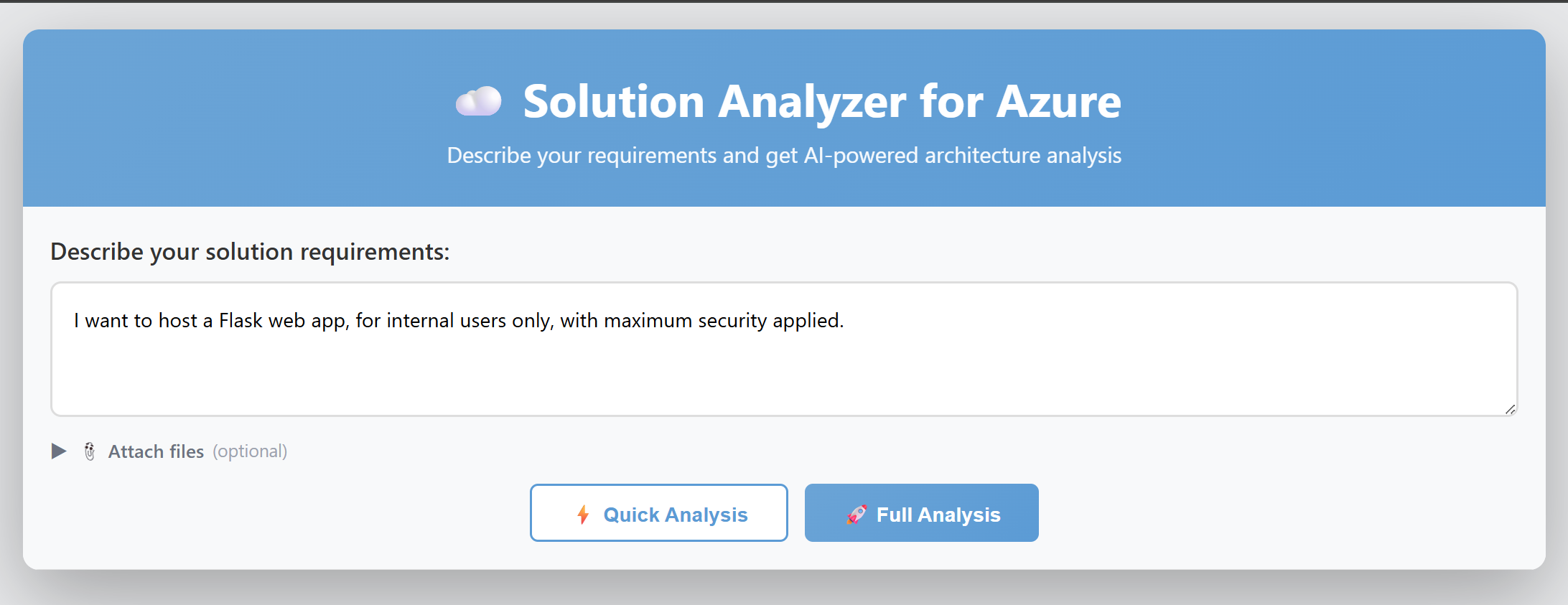
Accelerate cloud architecture design for every application onboarding. Our AI-powered Solution Analyzer evaluates your workload requirements against the Well-Architected Framework, generates Azure topology recommendations, and forecasts infrastructure costs — all within an agentic workflow.
Explore the live application and analyze your architecture.
Run AnalysisLet us design a Well-Architected landing zone tailored to your workloads and compliance requirements.